native · postgres + mysql · macOS

The database is live, not static.

PhosphorDB is a native database explorer for cloud-native Postgres and MySQL. Tables, grids, hot queries and topology move as your app writes. Every fix leaves as a pull request.

Illustration of the live data grid. The table shop.orders receives new rows at the top, each flashing briefly, and an occasional status cell changes. It is generated in your browser and pauses when off screen.

performance

Fast because it’s native.

9.3 ms

frame interval p99 on a live table, stream tier

2.10 ms

SQL editor, keystroke to paint, p99

1.5 ms

jump to a position in a 1M-row table, median

0 frames

frames drawn in 10 s by an idle replication topology

All the numbers

01 — design

Built like an instrument.

One accent for the things that matter: the primary action and live signals. Hairlines instead of boxes. Square corners. A quiet table stays perfectly still.
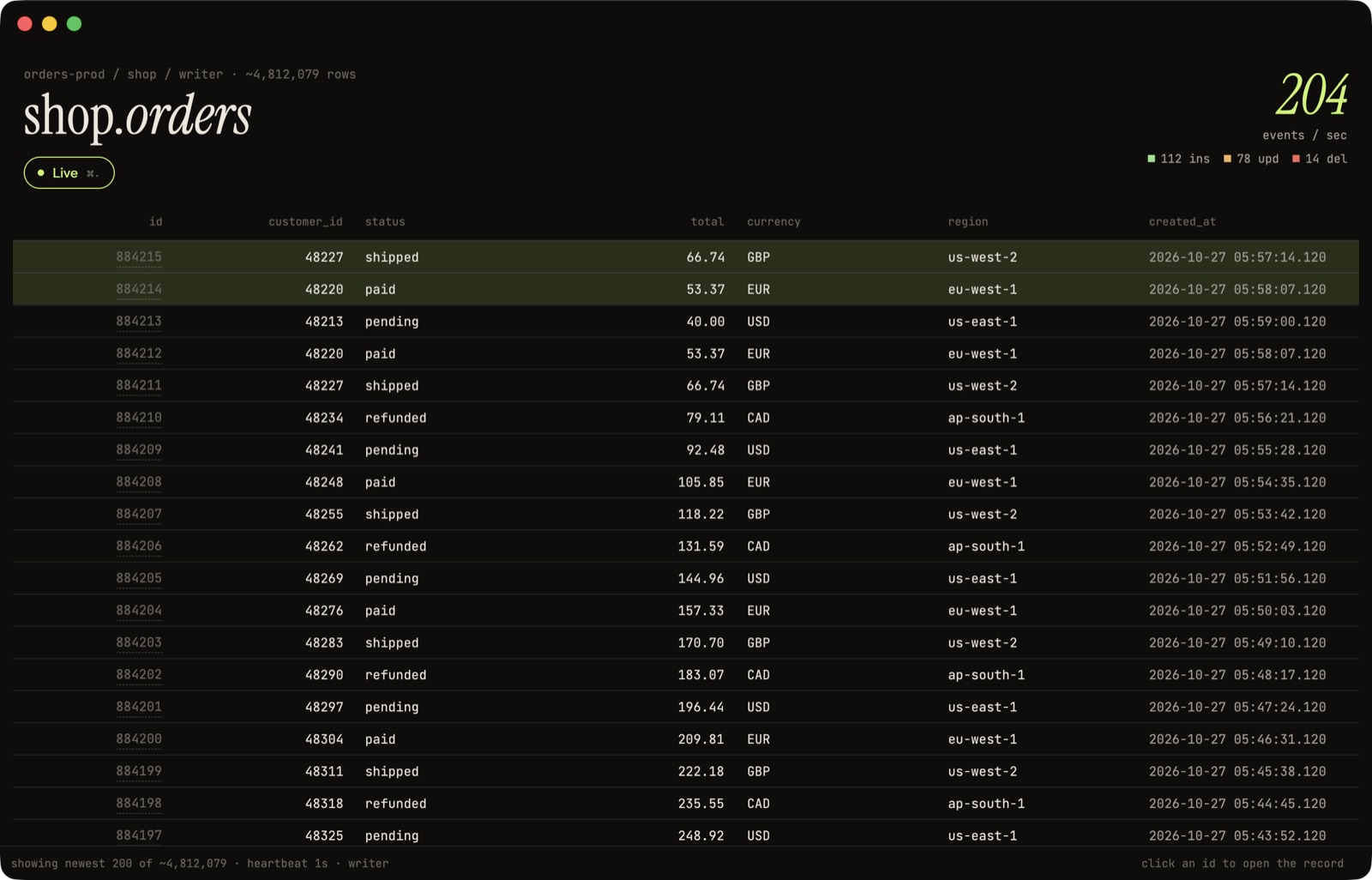
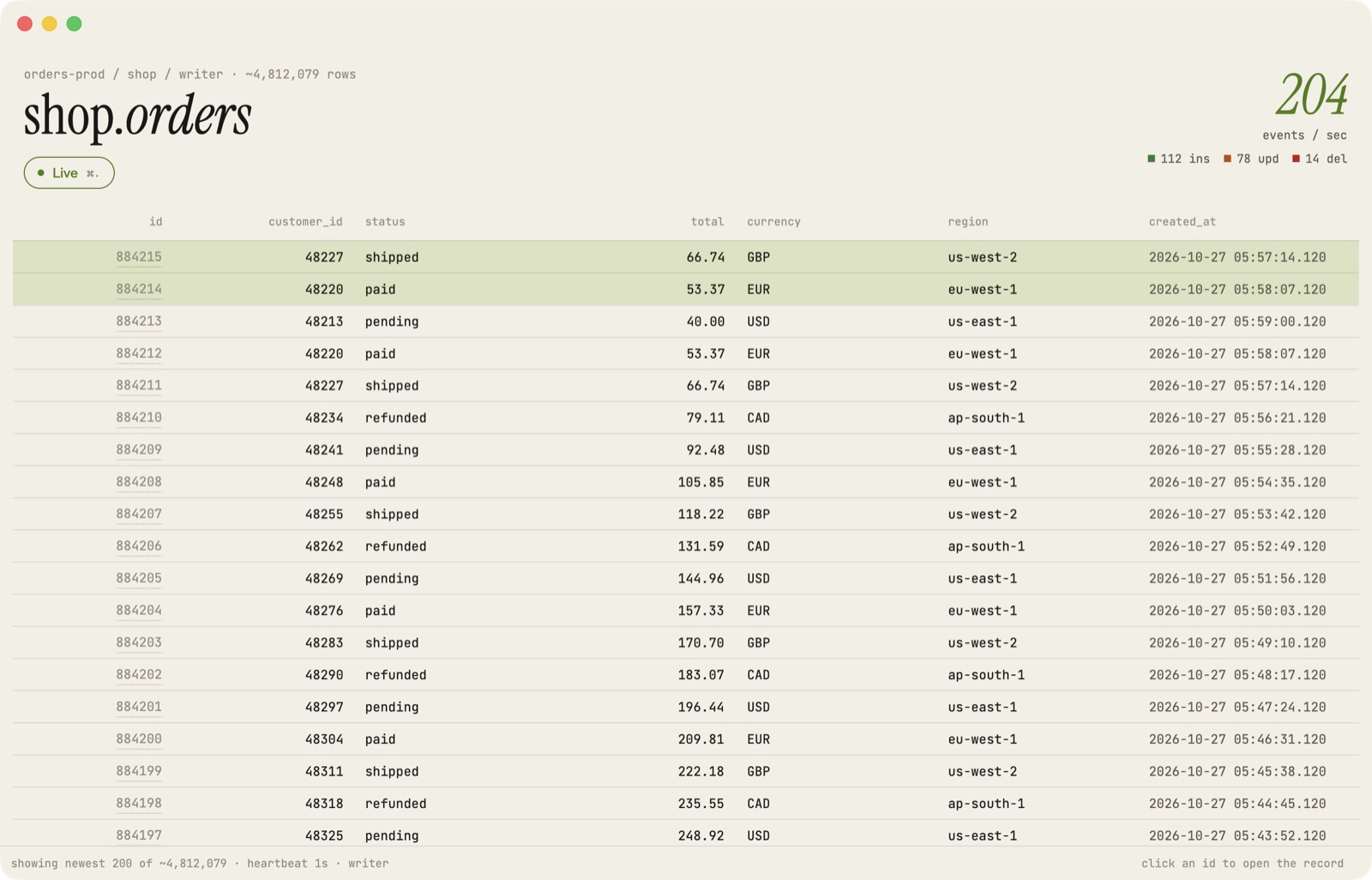
PhosphorDB live data grid: shop.orders with newly inserted rows tinted, a Live pill and an events per second counter. PhosphorDB live data grid: shop.orders with newly inserted rows tinted, a Live pill and an events per second counter.
shop.orders · live · inserts flash in, then settle
bgsurface
panel2panel
raisedinput
textink
dimsecondary
accentlive
insinsert
updupdate
deldelete
readreader
Replication topologyInstrument Serif · display
Pending writesInstrument Sans · interface
orders-prod / shopJetBrains Mono · data and code

Quiet is still

Motion means data changed. When a table has no writes, nothing on screen moves.

Dark and light

Both themes are first class. This site uses the same tokens as the app. Try the toggle at the top.

Honest labels

The data source is always named: heartbeat · 1s, sampled, streaming from binlog. Never more than is true.

02 — what it does

See it live. Open the row. Find the hot query.

Watch the writes arrive

Tables, counts and rows update as your application writes. Start with a cheap heartbeat. Opt into a stream for a table and each insert flashes in, each update lights up its cell.
  • Postgres logical replication and MySQL binlog, per viewed table
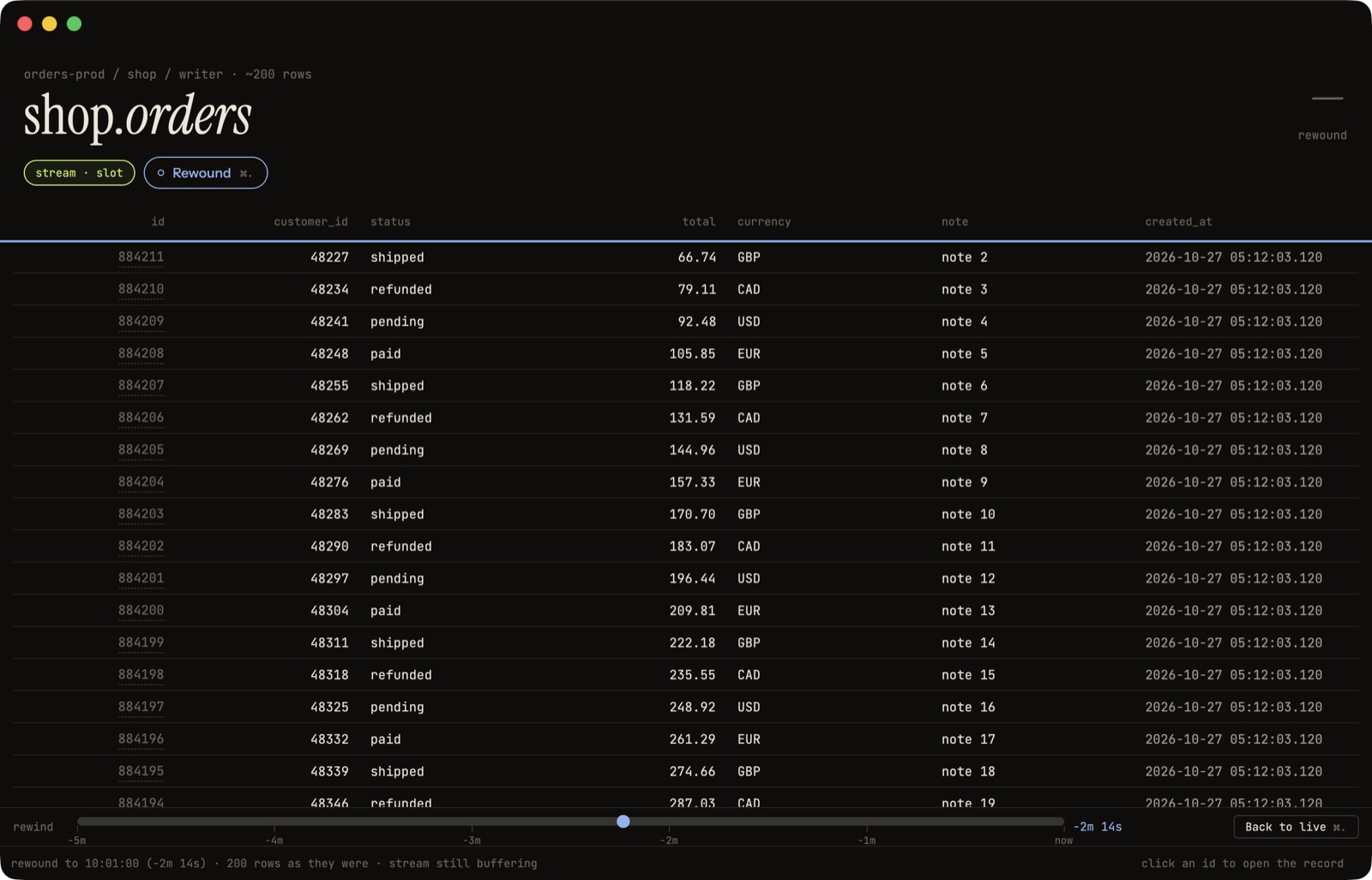
  • Scrub back through the last five minutes
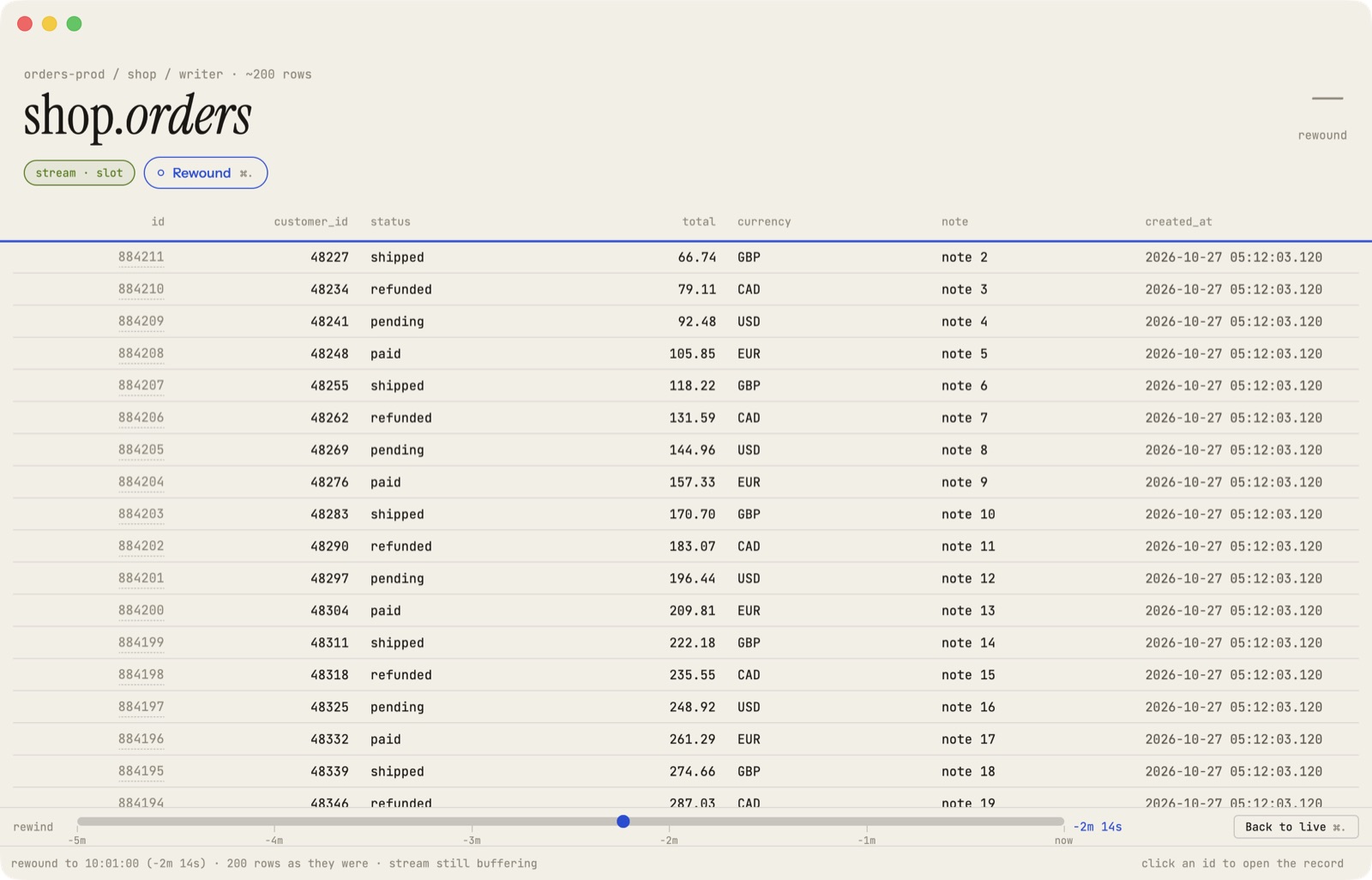
The time scrubber rewinding a live grid across the last five minutes of changes. The time scrubber rewinding a live grid across the last five minutes of changes.
the time scrubber · the last five minutes

Open the row as a model

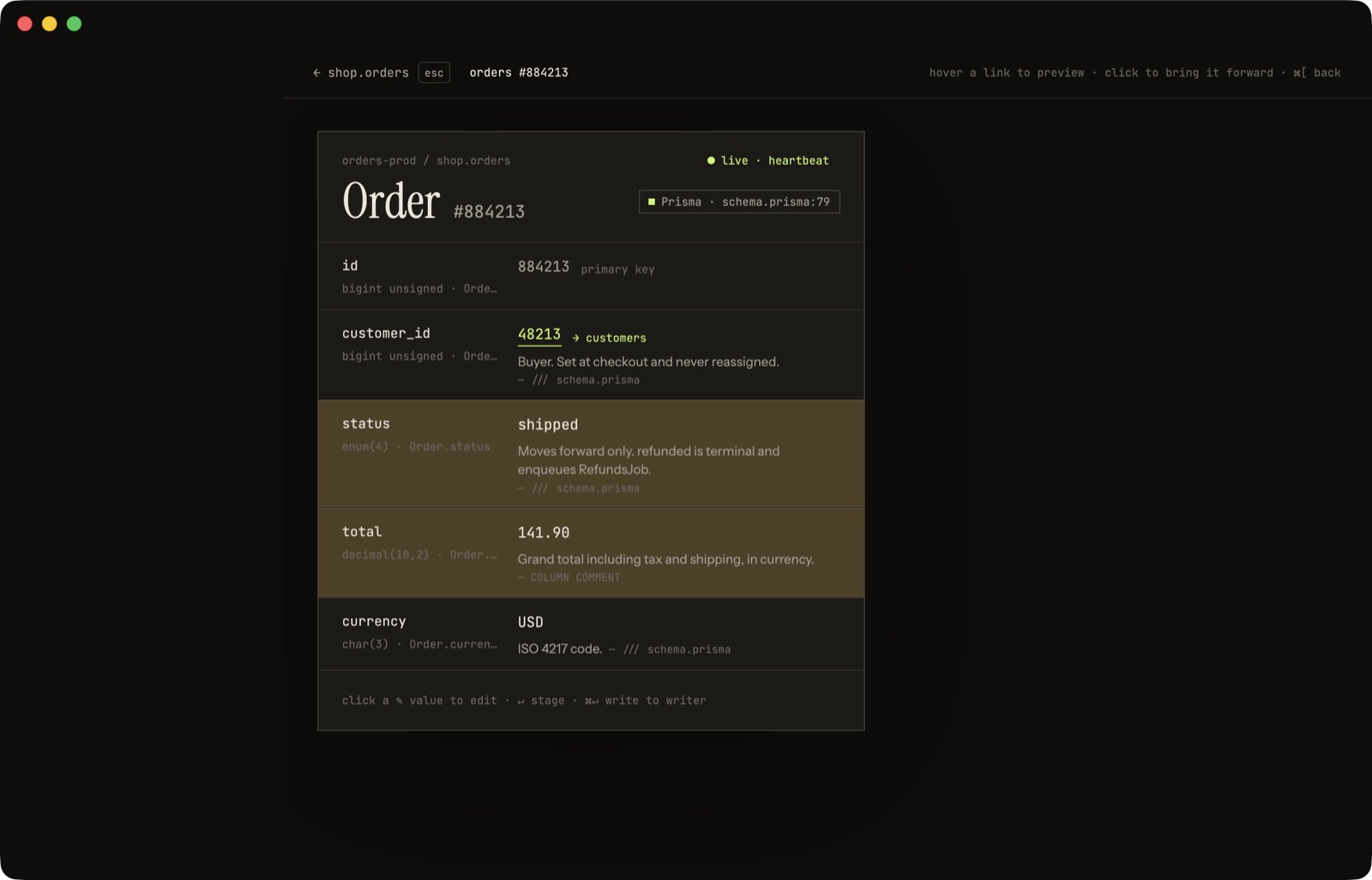
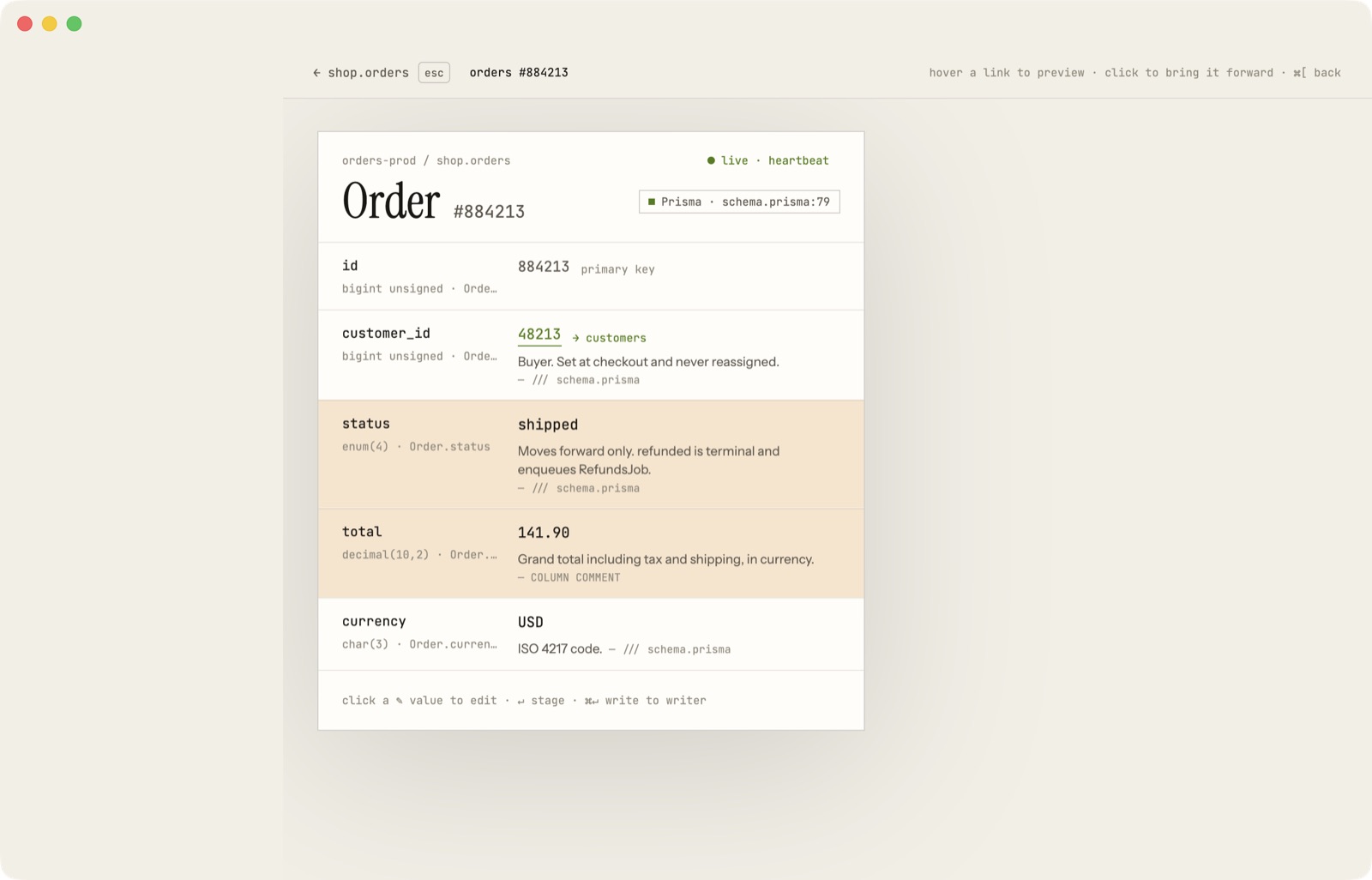
A record view with relations you can walk. Follow a foreign key, see the rows that point back, read ORM descriptions from your repo. Edit a field and it is staged, never fired.
  • Navigable relations, both directions
  • Staged edits with the exact statement shown
The record view for one order: fields with descriptions from the Prisma schema, a link from customer_id to the customers table, and changed cells highlighted. The record view for one order: fields with descriptions from the Prisma schema, a link from customer_id to the customers table, and changed cells highlighted.
the record view · live, with descriptions from your schema

Find what is hot

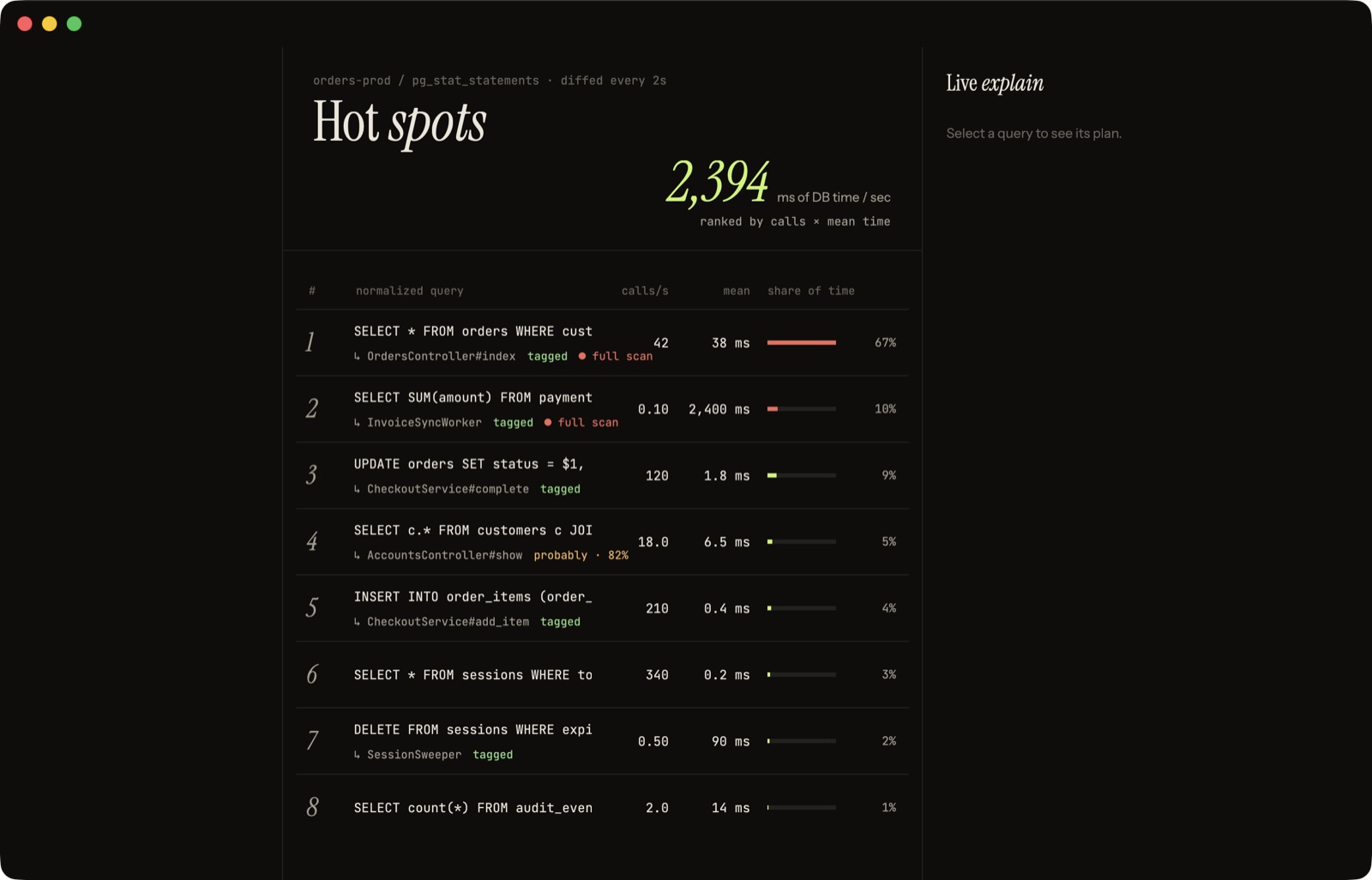
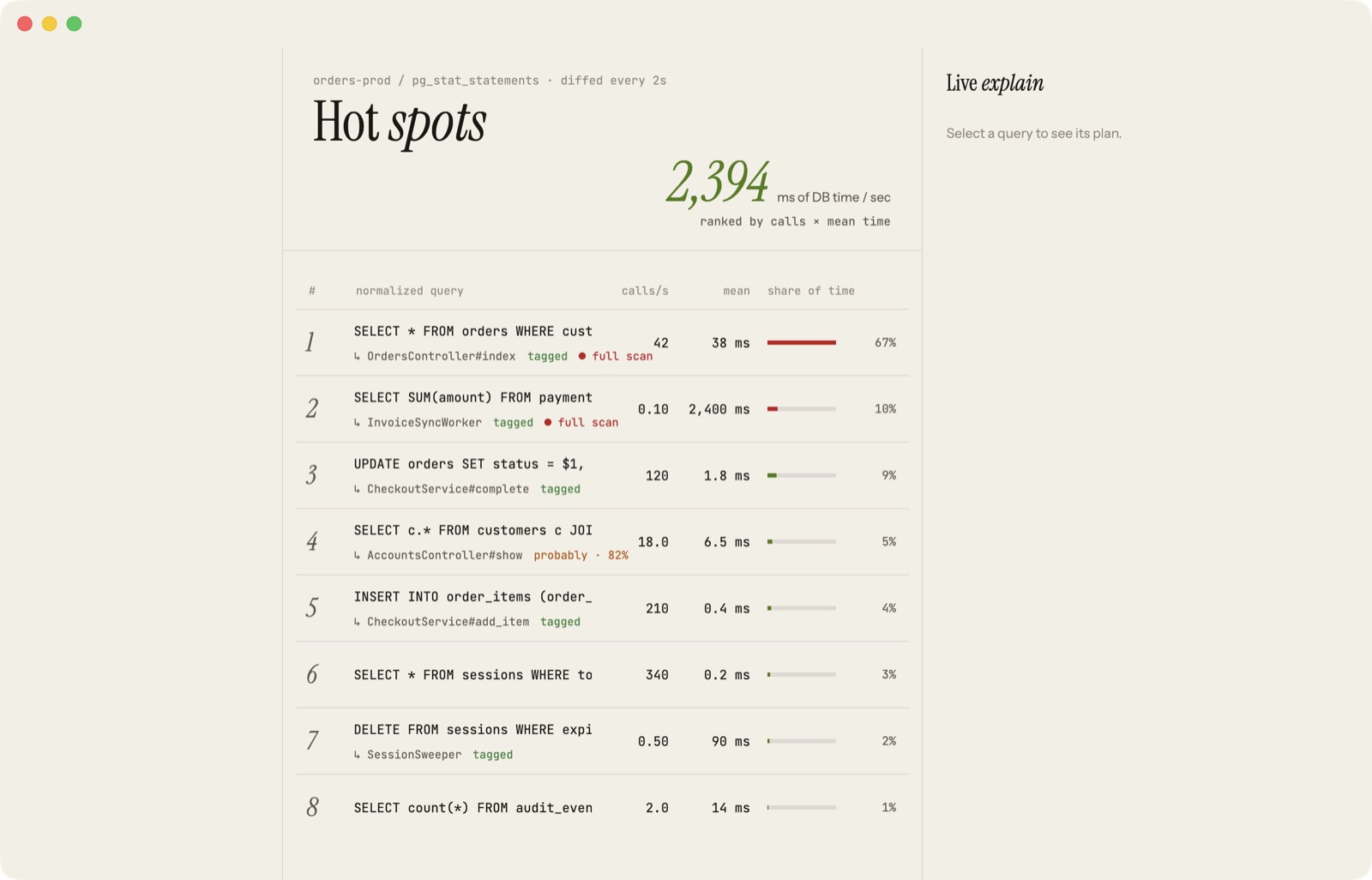
A live leaderboard of the queries costing you the most time, with a plan for each and a flag on full scans. Caused-by chips name the code path writing to a table.
  • Live EXPLAIN with estimates
  • Index suggestions you copy, not apply
The Hot spots view ranking normalized queries by share of database time, with caused-by code paths and full scan flags. The Hot spots view ranking normalized queries by share of database time, with caused-by code paths and full scan flags.
hot spots · ranked by calls × mean time

Your cluster, mapped

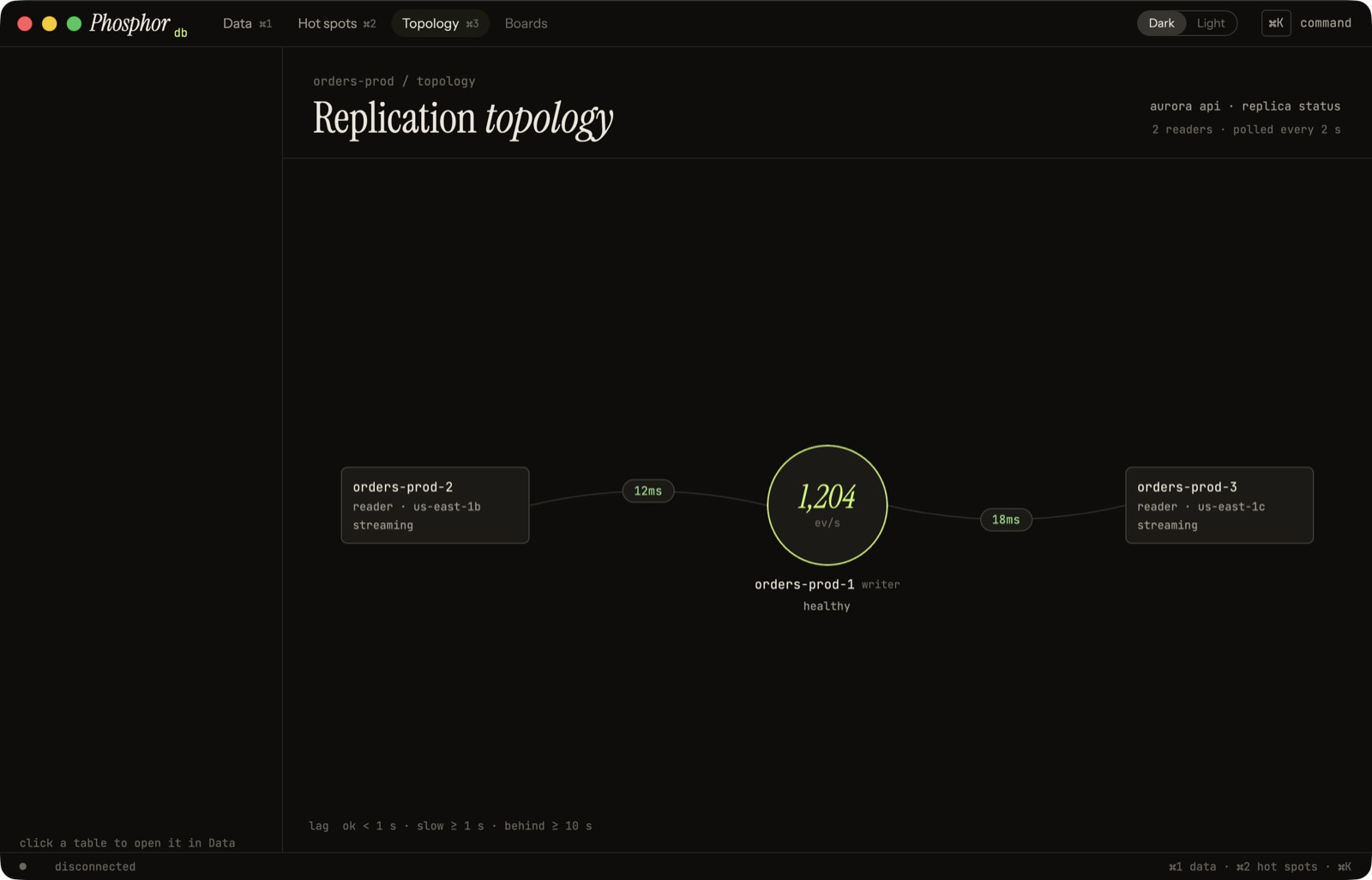
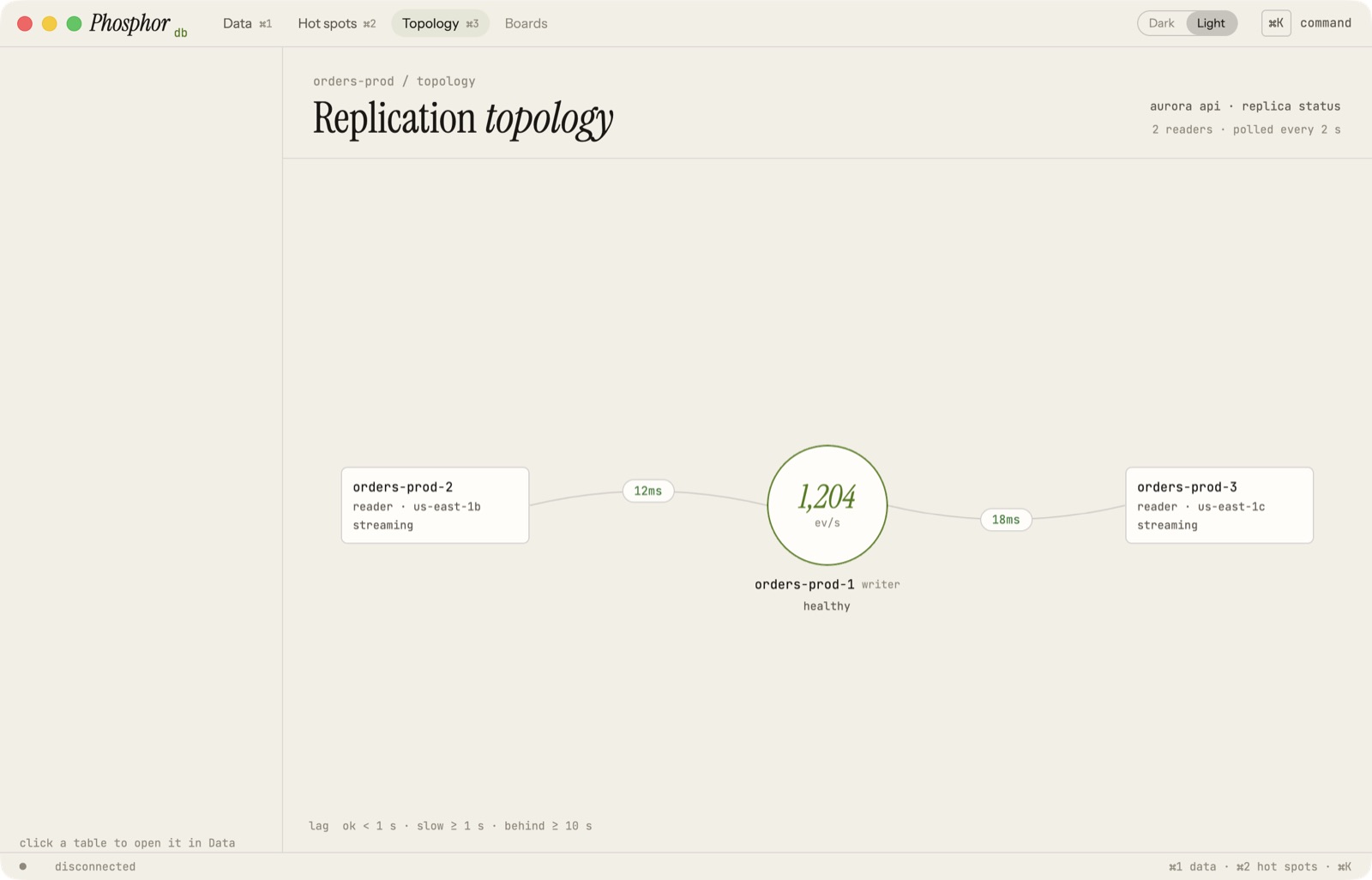
Discover Aurora clusters from your AWS profiles and CloudNativePG clusters from your kubeconfig. Tunnels and port-forwards are handled. The topology view shows writer, readers and lag.
  • IAM auth, SSM and SSH tunnels
  • Reads route to replicas, lag aware
The Replication topology view: a writer in the centre with two readers, and replication lag of 12 and 18 milliseconds on the links. The Replication topology view: a writer in the centre with two readers, and replication lag of 12 and 18 milliseconds on the links.
replication topology · writer, readers, lag

All features

03 — why it is different

Not another static snapshot.

live

Everything moves

Grids, hot queries, topology and the sidebar heat all follow the database as it changes. Desktop clients show you a snapshot. This shows you the system.

safe

No apply button

PhosphorDB never applies schema or infrastructure changes to a live system. Row edits are explicit, staged and written with a visible statement. Fixes become pull requests.

cloud-native

Found, not typed

Clusters come from your AWS profiles and kubeconfigs. Auth, tunnels and port-forwards are the tool’s job, not a ritual before every session.

cheap

Liveness costs little

A one second heartbeat by default. Replication slots and binlog streams are opt-in per table, temporary, cleaned up, and their state is shown.

native

Fast by construction

A Rust core and a GPU-rendered interface. No browser engine, no Electron. Built to hold smooth frame rates while a hot grid updates.

keyboard

Everything on ⌘K

Every action is reachable from the command palette. Shortcuts are shown where you use them.

04 — roadmap

Where it is going.

Now

In progress.

  • Live charts and BoardsSuggest a chart from any result and pin it to a live board.

Next

Planned, in order.

  • Read-only server modeBoards served from inside your cluster to a web page.
  • Index pull requestsA hot query to an index PR in two clicks.

Later

Direction, not promises.

  • Schema editor and migrationsDesigned against real data, shipped as a PR.
  • Topology edit to IaC PRsReplica changes as reviewed infrastructure PRs.

Full roadmap

download

Watch your database move.

PhosphorDB for macOS is coming. Postgres and MySQL, native, fast, and quiet when your data is.